
Scoliosis Assessment
Choosing scoliosis or hyperkyphosis care starts with an accurate and complete assessment
How is Scoliosis Assessed?
Accurate assessment of a scoliosis or hyperkyphosis case, is a critical first step in achieving the best outcomes for a patient. A thorough assessment, by a dedicated scoliosis clinician, will help in fully understanding the case, and choosing the right treatment path for you, or a loved one.
ScoliCare® approach to scoliosis treatment is to ensure each curve is accurately assessed from the outset and that we provide appropriate non-surgical treatment options tailored to each patient or recommend surgery if necessary.
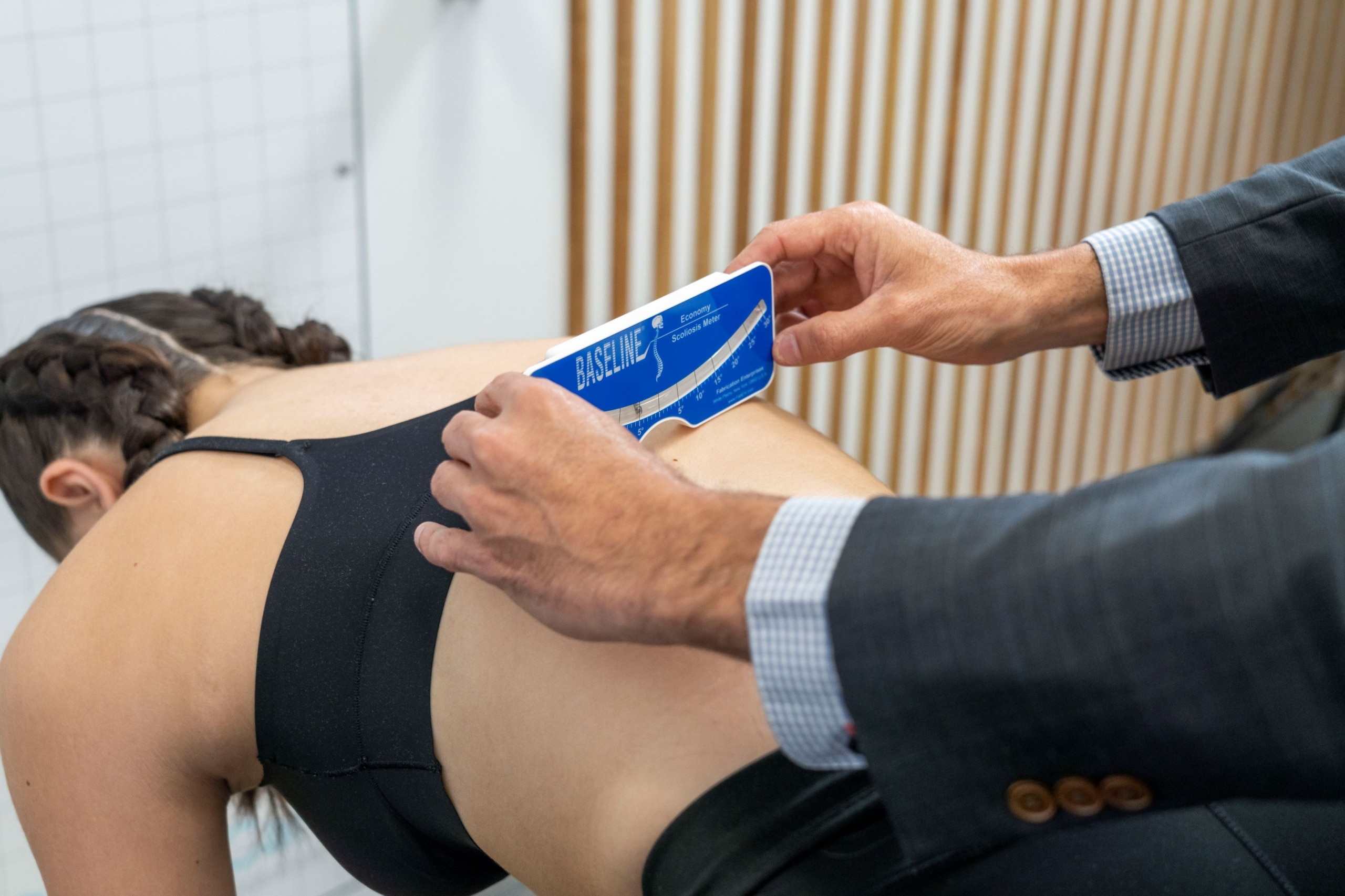
Physical Assessment including Posture
Scoliosis and hyperkyphosis can usually be initially detected through physical assessment.
The first signs of scoliosis are often postural, for example, an uneven tilt of the shoulders or one side of the rib cage protruding more than the other. Signs of hyperkyphosis may include a slouch or hunching appearance of the mid back.
A thorough postural assessment by a clinician, including the Adams forward bending test, is usually enough to determine if further assessment is required which normally includes an X-ray.
How is Scoliosis Assessed?
The first step in scoliosis or hyperkyphosis care is a thorough assessment. A clear assessment ensures your situation is fully understood and that the most appropriate treatment pathway can be planned for you.
Scoliosis assessments are suitable for children, teens, and adults who:
- Have been told they may have scoliosis or hyperkyphosis
- Have noticed changes in posture (like uneven shoulders or ribcage) or pain
- Already have X-rays and want to understand what they mean
What to Expect
The assessment begins with a review of your medical history, followed by a physical examination.
During the physical check, the clinician looks at posture for signs such as uneven shoulders, one side of the ribcage sticking out, or a hunched appearance. They may also use the Adams forward bend test – you bend forward, and they check whether your spine curves. If scoliosis is suspected, the next step is usually an X-ray.
X-Rays & Cobb Angle
An X-ray is the only way to confirm scoliosis or hyperkyphosis. Standing X-rays are used because they show how the spine looks in its natural, upright position.
From these images, the clinician measures the Cobb angle – the key number that shows how severe the curve is. At ScoliCare, every curve is carefully measured to ensure you get clear guidance on the most appropriate treatment, whether that’s scoliosis specific exercise, custom scoliosis bracing, or, if needed, referral for surgery.
For children, X-rays also help assess bone age, helping predict future growth and risk of progression of the curve. In adults, the focus is on whether the spine is stable and posture is balanced.
Already have X-rays?
We offer a free online review service to provide a second opinion. Please note: we review scoliosis and hyperkyphosis X-rays only.
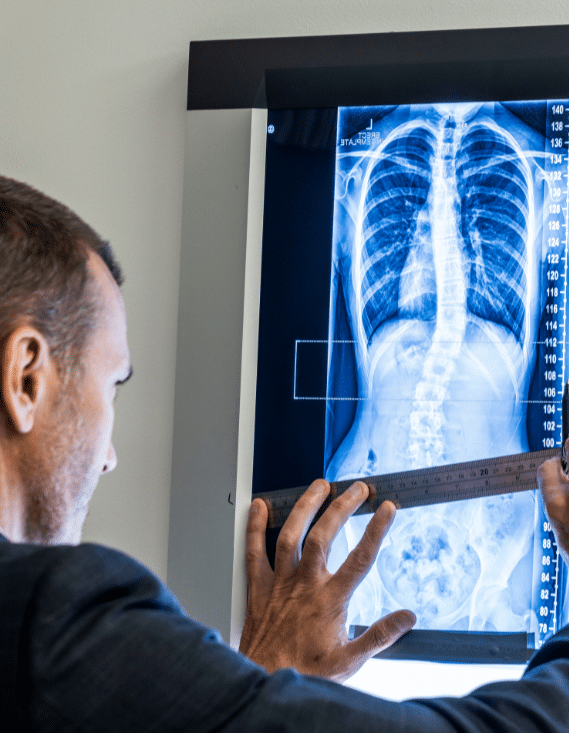
X-rays and the Cobb Angle
An X-ray is the only way to accurately diagnose and measure a scoliosis (or hyperkyphosis). Only standing X-rays should be used as they show the true degree and alignment of the curve or curves while the patient is upright.
Lying down X-rays are not as useful as the spine can be mispositioned and the true extent of the scoliosis minimized.
Once X-ray images have been taken, a type of measurement called the “Cobb angle” is used to assess the degree of the scoliosis.
It is critical that any health professional assessing scoliosis is familiar and accurate with this measurement as it is then used to form recommendations for treatment options based on the degree of curve.
For children, an X-ray is also fundamental to assess the bone age which gives the clinician useful information regarding future spinal growth and the risk of curve progression.
In older adults, X-rays also play an important role in assessing spinal balance and the presence of any spinal instability.
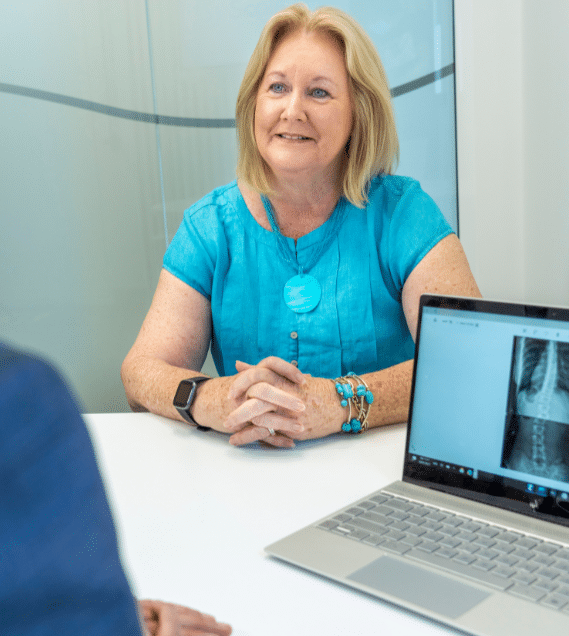
If you already have X-rays, we can offer a second opinion. Reviewing existing X-rays is a free online service. Note that we review scoliosis and hyperkyphosis X-rays only.
What Scoliosis Measurements Mean
Scoliosis is defined as a curve of more than 10 degrees on the Cobb angle, with visible rotation of the vertebrae. If no rotation is seen, the curve isn’t a true scoliosis – it may be postural or positional.
The size of the curve plays a big role in guiding treatment and predicting whether it could worsen over time:
- Small curves (under 20 degrees): Treatment may include scoliosis specific exercises (such as ScoliBalance®) or part-time scoliosis specific bracing.
- Moderate curves (over 25 degrees): Exercises alone are generally not enough, and full-time bracing (such as ScoliBrace®) may be recommended in conjunction with scoliosis specific exercises.
- Severe curves (over 60 degrees): Surgery may be considered.
Want clarity on your next step?
Book an in-person scoliosis assessment at your nearest ScoliCare clinic to discuss your results and possible treatment options.

Success Stories from our Clinics
Thank you to these patients for allowing us to share their case studies.
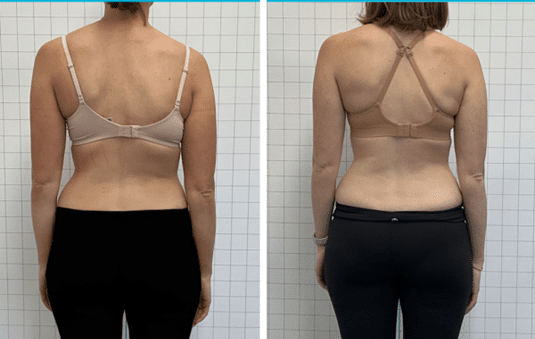
27 y/o Female – Adolescent Idiopathic Scoliosis in the Adult
Treatment of scoliosis using the ScoliBalance Program in an Adult Female Patient Read more

Case – Adolescent Bracing (12 year old male)
Treatment of scoliosis for an adolescent patient using bracing. Read more
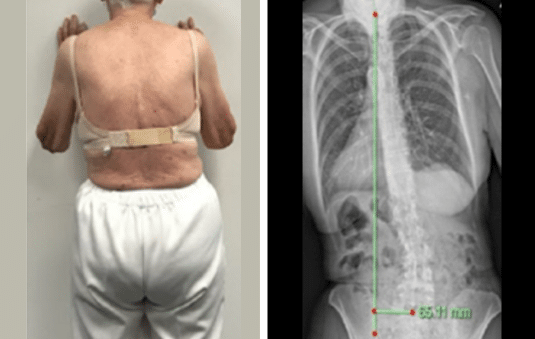
Case – Adult Bracing (87 year old female)
Female aged 87 years with adult degenerative scoliosis. Treatment of a severe scoliosis using a 3D designed custom scoliosis brace in an Older Female Patient Read more
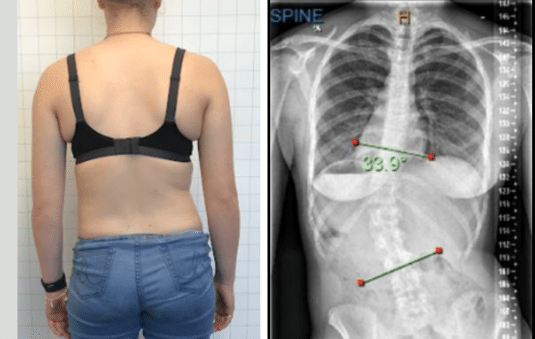
Case – Adolescent Bracing (14 year old female)
Female aged 14 years with a 34° thoracolumbar curve. Reduction of Severe Scoliosis using a 3D Designed Custom Scoliosis Orthosis in a Young Active Female Read more
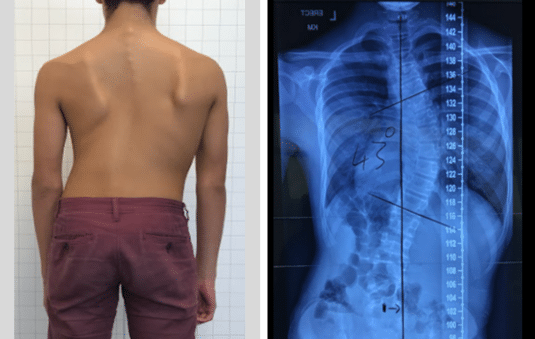
Case – Adolescent Bracing (12 year old male)
Reduction of a severe scoliosis in a young active male, using a 3D designed custom scoliosis orthosis and ScoliBalance Read more
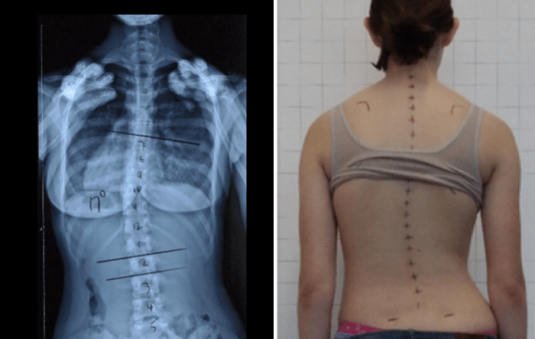
Case – Scoliosis Specific Exercise (14 year old female)
Reduction of a postural scoliosis in an adolescent using ScoliBalance (Scoliosis Specific Exercise Rehabilitation) Read more
Find Your Nearest Clinic
ScoliCare Clinics, affiliates and product providers are in over 200 locations around the world. Find your nearest ScoliCare location here.

Find Your Nearest Clinic
ScoliCare Clinics, affiliates and product providers are in over 200 locations around the world. Find your nearest ScoliCare location here.
Find Your Nearest Clinic
ScoliCare Clinics, affiliates and product providers are in over 200 locations around the world. Find your nearest ScoliCare location here.


Find Your Nearest Clinic
ScoliCare Clinics, affiliates and product providers are in over 200 locations around the world. Find your nearest ScoliCare location here.